Optimize reductions
Single instruction, multiple data (SIMD) code for reduction operation loops
Since R2022a
Model Configuration Pane: Code Generation / Optimization
Description
The Optimize reductions parameter instructs the code generator to generate single instruction, multiple data (SIMD) code for reduction operation loops. A reduction is an operation that reduces a set of elements, such as an array, to a single value using an associative binary operator. For example, calculating the sum of the elements in an array is a reduction operation that uses the addition operator. Reduction operations are generated from blocks such as Sum of elements and Product of elements blocks.
Dependencies
To use this parameter, you must set Instruction set extensions to a valid instruction set.
Settings
off (default) | on- On
Generates single instruction, multiple data (SIMD) code for reduction operation loops.
- Off
Generates non-parallel
forloops for reduction operations.
Examples
This example shows how to generate optimized single instruction, multiple data (SIMD) code that performs reduction operations.
Example Model
Open the example model ex_rowmajor_algorithm. The model calculates the sum of the elements in a 4 by 3 by 2 array.
model = 'ex_rowmajor_algorithm';
open_system(model)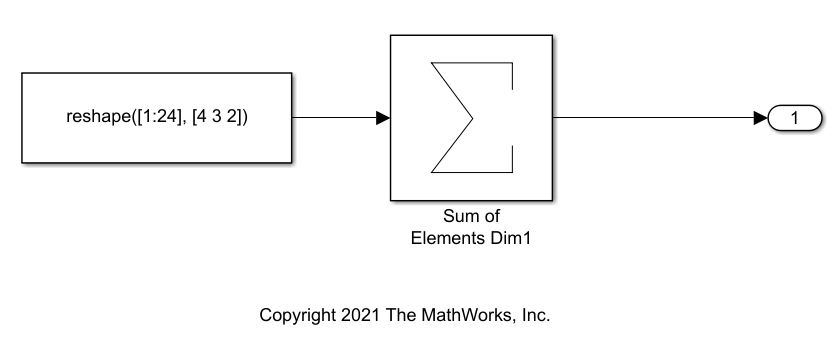
Generate SIMD Code Without Reduction Optimization
Open the configuration parameters for the model. On the Modeling tab, click Settings. On the Code Generation pane, set System target file to grt.tlc. On the Optimization pane, set the Leverage target hardware instruction set extensions to SSE2. Alternatively, use the command-line.
set_param(model, 'SystemTargetFile', 'grt.tlc');
set_param(model, 'SaveOutput', 'off');
set_param(model, 'RTWVerbose', 'off');
set_param(model, 'InstructionSetExtensions', 'SSE2');
De-select the parameter Optimize reductions.
set_param(model, 'OptimizeReductions', 'off');
Build the model.
slbuild(model);
### Searching for referenced models in model 'ex_rowmajor_algorithm'.
### Total of 1 models to build.
### Starting build procedure for: ex_rowmajor_algorithm
### Successful completion of build procedure for: ex_rowmajor_algorithm

Build Summary

Top model targets:

Model                  Build Reason                                         Status                        Build Duration
========================================================================================================================
ex_rowmajor_algorithm  Information cache folder or artifacts were missing.  Code generated and compiled.  0h 0m 57.103s

1 of 1 models built (0 models already up to date)
Build duration: 0h 1m 2.5713s
Inspect the generated ex_rowmajor_algorithm_step function.
file = fullfile('ex_rowmajor_algorithm_grt_rtw','ex_rowmajor_algorithm.c');
coder.example.extractLines(file,'/* Model step function */','/* End of Sum',1,1);
/* Model step function */
void ex_rowmajor_algorithm_step(void)
{
  int32_T i;

  /* Sum: '<Root>/Sum of Elements Dim1' incorporates:
   *  Constant: '<Root>/Constant1'
   */
  ex_rowmajor_algorithm_Y.Out2 = -0.0F;
  for (i = 0; i < 24; i++) {
    ex_rowmajor_algorithm_Y.Out2 +=
      ex_rowmajor_algorithm_ConstP.Constant1_Value[i];
  }

  /* End of Sum: '<Root>/Sum of Elements Dim1' */
The generated code contains a non-vectorized loop that adds each array element individually.
Generate SIMD Code With Reduction Optimization
Open the configuration parameters for the model. On the Modeling tab, click Settings. On the Optimization pane, set the Leverage target hardware instruction set extensions to SSE2. Alternatively, use the command-line.
set_param(model, 'InstructionSetExtensions', 'SSE2');
Select the parameter Optimize reductions.
set_param(model, 'OptimizeReductions', 'on');
set_param(model, 'MatFileLogging', 'off');
Build the model.
slbuild(model);
### Searching for referenced models in model 'ex_rowmajor_algorithm'.
### Total of 1 models to build.
### Starting build procedure for: ex_rowmajor_algorithm
### Successful completion of build procedure for: ex_rowmajor_algorithm

Build Summary

Top model targets:

Model                  Build Reason                     Status                        Build Duration
====================================================================================================
ex_rowmajor_algorithm  Generated code was out of date.  Code generated and compiled.  0h 0m 12.186s

1 of 1 models built (0 models already up to date)
Build duration: 0h 0m 12.926s
Inspect the generated ex_rowmajor_algorithm_step function.
file = fullfile('ex_rowmajor_algorithm_grt_rtw','ex_rowmajor_algorithm.c');
coder.example.extractLines(file,'/* Model step function */','/* Matfile',1,1);
/* Model step function */
void ex_rowmajor_algorithm_step(void)
{
  __m128 tmp;
  int32_T i;
  real32_T tmp_0[4];
  tmp = _mm_set1_ps(0.0F);

  /* Sum: '<Root>/Sum of Elements Dim1' incorporates:
   *  Constant: '<Root>/Constant1'
   */
  for (i = 0; i <= 20; i += 4) {
    tmp = _mm_add_ps(tmp, _mm_loadu_ps
                     (&ex_rowmajor_algorithm_ConstP.Constant1_Value[i]));
  }

  /* End of Sum: '<Root>/Sum of Elements Dim1' */
  _mm_storeu_ps(&tmp_0[0], tmp);

  /* Outport: '<Root>/Out2' */
  ex_rowmajor_algorithm_Y.Out2 = (tmp_0[0] + tmp_0[1]) + (tmp_0[2] + tmp_0[3]);
}

/* Model initialize function */
void ex_rowmajor_algorithm_initialize(void)
{
  /* Registration code */

  /* initialize error status */
  rtmSetErrorStatus(ex_rowmajor_algorithm_M, (NULL));

  /* external outputs */
  ex_rowmajor_algorithm_Y.Out2 = 0.0F;
}

/* Model terminate function */
void ex_rowmajor_algorithm_terminate(void)
{
  /* (no terminate code required) */
}
The vectorized loop uses the SSE2 function mm_add_ps, which adds four elements of the array to the sum in one step. This optimization improves the execution speed of the generated code.
Open the code generation report. On the C Code tab, click Open Report.

On the report summary, in the Additional Information section, the report indicates that reduction operations are optimized using the SSE2 instruction set.
Recommended Settings
| Application | Setting |
|---|---|
| Debugging | No impact |
| Traceability | No impact |
| Efficiency | On (execution speed) |
| Safety precaution | Off |
Programmatic Use
Parameter: OptimizeReductions |
| Type: character vector |
Value: 'on' | 'off' |
Default: 'off' |
Version History
Introduced in R2022a

