Maritime Operations using Argo Profiling Float, Underwater Glider, and Wave Buoy
R2026bThis example shows how to model three autonomous maritime vehicles, a profiling float, an underwater glider, and a wave buoy, with the Aerospace Blockset™ Maritime Applications Library in Simulink®, and then compose them into a single ocean-observing fleet with System Composer™.
Opening the Maritime Operations Project
Run the following command to create and open a working copy of the project files for this example.
openProject('asbMaritimeOperations');To step through building each vehicle, composing the fleet, and sweeping the mean ocean current, run ExampleWalkthrough.m from the project Home page.
Argo Profiling Float
This example models the profiling float with a 6DOF Hydrostatic (Standard Shape) block using a cylinder shape with a PID depth controller. The controller models a variable-buoyancy engine with a saturation limit by controlling a vertical force through the applied-force input. The Temperature Salinity and Pressure Density blocks supply the in-situ seawater density at the float position, and the Subsea Altitude block reports clearance above the seafloor generated by the Terrain Generator block.
Underwater Glider
This example models the underwater glider with a 6DOF Hydrostatic (Standard Shape) block using a cuboid shape with an open-loop body-frame force schedule and a yaw controller that holds the survey bearing. The mean ocean current biases the glider ground track off its planned path.
Wave Buoy
This example models the wave buoy with a 6DOF Hydrostatic (Standard Shape) block using a sphere shape with no controller and no applied force. Heave and attitude come entirely from the wave field, generated by the Irregular Wave block, acting through the hydrostatic force and moment.
Fleet Architecture
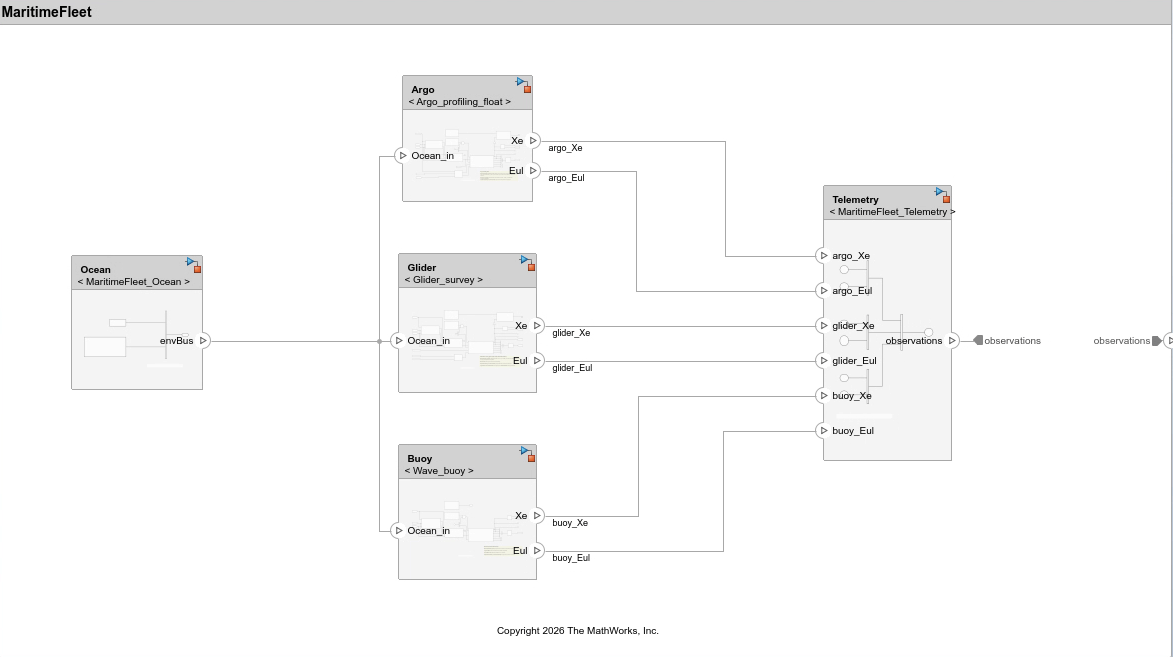
A System Composer architecture composes the three vehicles with a shared ocean environment component and a telemetry component that aggregates their data outputs.
The example builds all three vehicles around the same 6DOF Hydrostatic (Standard Shape) block. Each vehicle makes a different term of its hydrostatic force balance dominant:
The profiling float rides the buoyancy-weight margin under closed-loop depth control.
The glider is driven by an applied body-frame external force.
The buoy responds to wave forcing.
The vehicles share one ocean, the same wave field, mean ocean current, seawater state, and seafloor, so the fleet output can be read as simultaneous measurements of one water column at three complementary geometries.
See Also
6DOF Hydrostatic (Standard Shape)

