Choose the Right Agent for Your Problem
R2026bWhen choosing an agent, best practice is to start with a simpler (and faster to train) algorithm that is compatible with your action and observation spaces. You can then try progressively more complicated algorithms if the simpler ones do not perform as desired.
Note that PG and AC agents are earlier (and simpler) implementation of policy gradient and actor-critic concepts. While these agents might be relatively easier to tune and memory efficient, in general they have very little functional advantages with respect to PPO, SAC, TD3 and DQN, and are provided mostly for educational purposes.
Similarly, PPO generally performs better than TRPO along all dimensions (with TRPO also being particularly hard to tune). Furthermore, TRPO only supports actors and critics with deep networks for which higher order derivatives can be calculated (therefore, you cannot use actors or critics with recurrent networks, custom basis functions or tables within a TRPO agent).
Discrete action spaces — For deterministic problems in which a satisfying linear-in-the-parameters approximation of a Q value function might exist (given a suitable set of features), the LSPI agent can learn a good policy quickly and in a relatively stable way, even when the state space is large.
For simple environments with a relatively small discrete action spaces, using a tabular approximator can be viable (provided that the observation space is also discrete). In these cases, the Q-learning and SARSA agents are the simplest compatible agent, with Q-learning usually performing better in terms of training speed and SARSA being slightly more robust.
Because the number of state-action pairs increases exponentially with the number of states and actions, tabular approximation does not scale well to environments with large state and action spaces, because it requires increasing memory and training time as the state space grows larger. In these cases, or when part of your observation space is continuous, unless a custom basis function suffices, use a network approximator.
The agents with discrete action space that support neural approximators are compared in the following picture. The off-policy agents (DQN and SAC) are on top and the four on-policy agents (PPO, TRPO, AC and PG) are on the bottom.
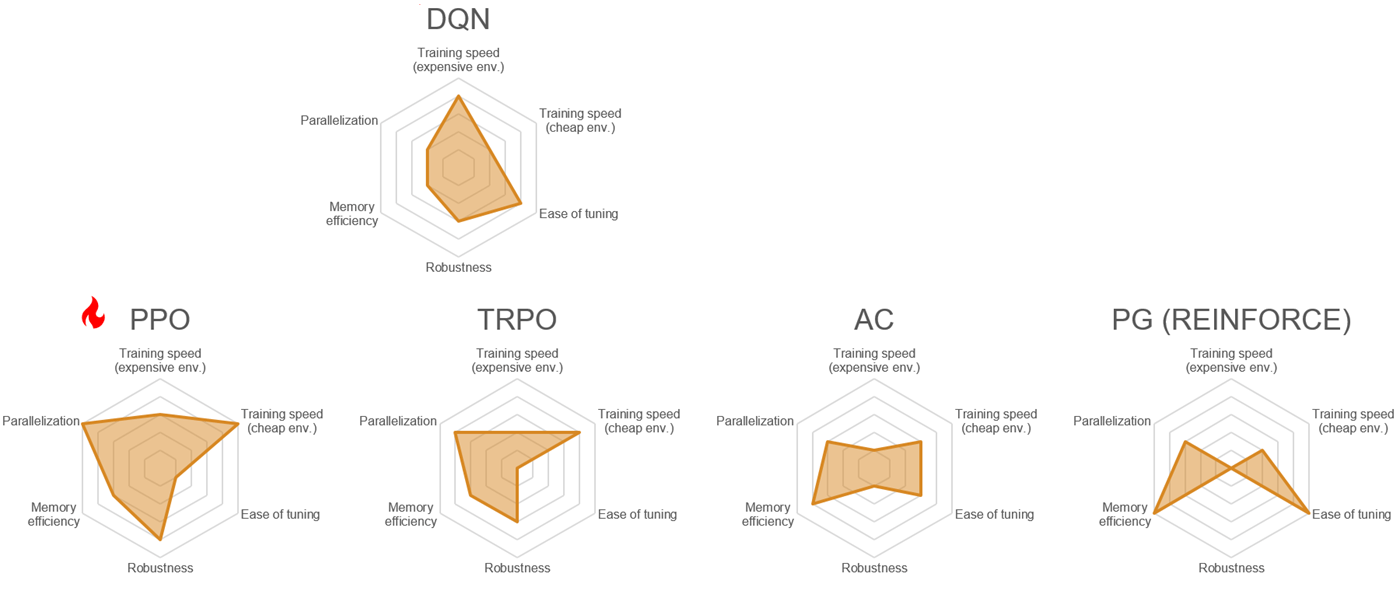
The agents are compared using six different metrics. There are two training speed metrics, for computationally expensive and computationally cheap environments, respectively. Ease of tuning is higher for agents that have less hyperparameters, or hyperparameters that are easier to understand and tune. Robustness is inversely related to the sensitivity to hyperparameters, weights, and initial conditions. Memory efficiency is inversely related to memory usage during training, and parallelization indicates how well the agent learning algorithm scales with the number of parallel workers.
The picture can be summarized as follows:
DQN and PPO exhibit good performance overall.
DQN is generally easier to tune (hence potentially a good starting point) and a relatively good choice for computationally expensive environments.
PPO and SAC have been developed recently, as indicated by the red symbol.
PPO tends to perform better in terms of parallelization and training speed for computationally cheap environments.
SAC tends to perform better in terms of robustness and training speed for computationally expensive environments.
Continuous action spaces — The agents with continuous action space that support neural approximators are compared in the following picture, with the three off-policy agents on the top and the four on-policy agents on the bottom.
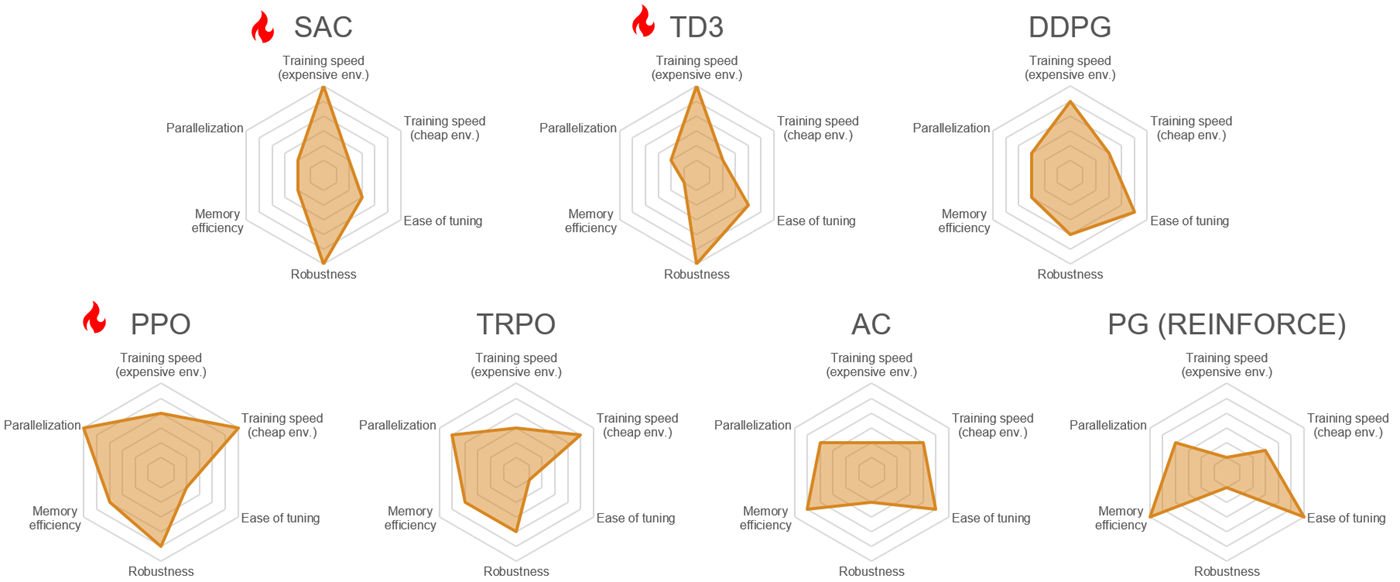
As for the previous picture, the first two metrics are the training speed for computationally expensive and computationally cheap environments, respectively. The ease of tuning is higher for agents that have less hyperparameters, or hyperparameters that are easier to understand and tune. Robustness is inversely related to the sensitivity to hyperparameters, weights, and initial conditions. Memory efficiency is inversely related to memory usage during training, and parallelization indicates how well the agent learning algorithm scales with the number of parallel workers.
The picture for agents that support continuous action spaces can be summarized as follows:
DDPG is the easiest to tune, followed by TD3, SAC and PPO.
DDPG is a good starting point, and tends to perform well overall.
Both TD3 and SAC are improved, more complex, and robust versions of DDPG, and are excellent choices for computationally expensive environments.
PPO is harder to tune but generally performs well overall. In particular, it is an excellent choice for computationally cheap environments, and is highly parallelizable.
SAC, which generates stochastic policies that can be useful for exploration, is slightly harder to tune but can be more memory efficient. This agent tends to perform very well for many environments.
Hybrid action spaces — Only SAC supports hybrid action spaces (that is, action spaces containing both a discrete and a continuous part). Hybrid action spaces are specified by two action channels, a discrete one and a continuous one. You can define these channels using a vector containing one
rlFiniteSetSpecobject followed by onerlNumericSpecobject.
See Also
Objects
rlQAgent|rlSARSAAgent|rlLSPIAgent|rlDQNAgent|rlPGAgent|rlDDPGAgent|rlTD3Agent|rlACAgent|rlSACAgent|rlPPOAgent|rlTRPOAgent|rlMBPOAgent

