One-Button Game Mini Hack Entry: Slowing Down to Catch Up [Orbital Rendezvous]
If you had to catch up with a spacecraft ahead of you in the same orbit, what would you do?
The intuition is to speed up and catch the spacecraft ahead. In orbit, that’s wrong. To catch something ahead of you, you burn retrograde and slow down.
Why burning retrograde works
Slowing down drops you into a lower orbit. A lower orbit is shorter and faster, so you complete each revolution sooner and gain on the spacecraft ahead every lap.
At the lowest point of that new orbit you’re actually moving faster than your target. Speeding up does the opposite: you climb higher, your orbit takes longer, and you fall behind.
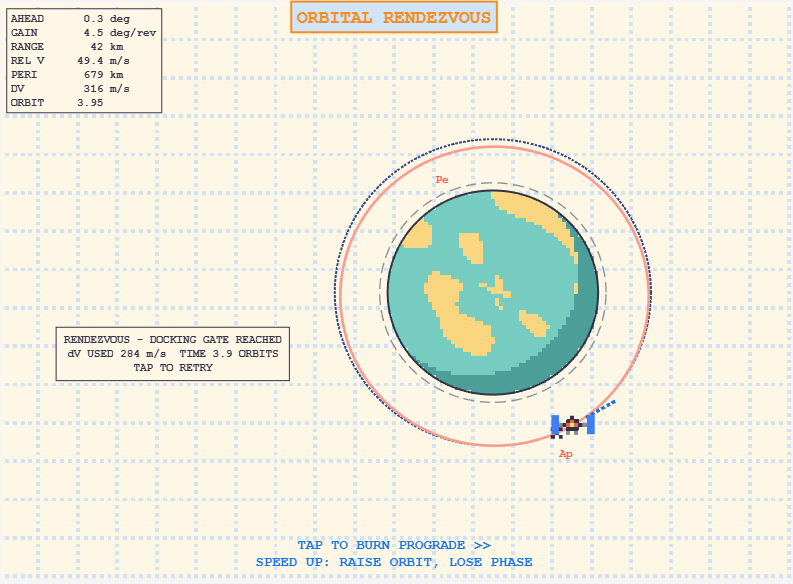
You start in the same 800 km circular orbit as a space station, trailing it by 25–55° with 400 m/s of Δv. One tap starts a burn and the next tap cuts the engine.
Burns alternate automatically: the first is retrograde, the second prograde, then retrograde again, and so on.
How to win
- Win: get within 200 km of the station with a relative speed below 50 m/s.
- Don’t burn up: if your orbit drops below 120 km altitude, you burn up in the atmosphere.
- Watch your fuel: you have 600 m/s of Δv.
- Beat the clock: you have 20 orbits to dock.
Key terms
- Prograde: thrusting along your direction of travel. Speeds you up and raises the opposite side of your orbit.
- Retrograde: thrusting against your direction of travel. Slows you down and lowers the opposite side of your orbit.
- Perigee: the lowest point of an orbit.
- Apogee: the highest point of an orbit.
What I learned building the game: realism vs. playability
I started out trying to make everything 1:1 with real orbital mechanics. It was physically accurate, but it was frustrating to play. Some trade-offs had to be made:
What I kept real
- The game simulates planar Keplerian dynamics. Burns are applied either along (prograde) or against (retrograde) your velocity vector.
- Orbital mechanics: to catch a station that’s ahead of you, you slow down. A retrograde burn reduces your semi-major axis a, and since the orbital period is T = 2π·sqrt(a³/μ), a smaller orbit has a shorter period. You gain on the station every revolution.
- The vis-viva equation v² = μ(2/r − 1/a), shows that speed is highest at periapsis and lowest at apoapsis. At the periapsis of your lower orbit you’re moving faster than the station, even though you got there by braking.
- To stop drifting, do a prograde burn back at the point where you first burned, which is now your apoapsis. Raising a back to the station’s radius recircularises your orbit and matches its period.
What I changed for playability
- Time warping. A real orbit at this altitude takes about 100 minutes. In the game it takes 8 seconds, roughly 750x real time.
- Burn in slow motion. Time runs 4x slower while the engine fires, so you can actually control how long a burn lasts with one button.
- A strong engine. Thrust is about 0.4 m/s², which is way higher than a normal spacecraft but it means a burn takes a few seconds instead of minutes.
- Exaggerated distance. In the game the distance from the station’s orbit is stretched 3x, otherwise the difference of the orbits wouldn't be visible.
- A generous docking gate. A realistic range (tens of km and relative velocity around 15 m/s) was nearly impossible to hit, so I widened it to 200 km and 50 m/s.
2 Comments
Time Descending
What I find particularly interesting is the balance between orbital fidelity and gameplay. The time compression, increased thrust, and expanded docking window make the mechanics accessible without losing the central ohysics of orbital rendezvous. I especialky like that the player has to manage not just distance, but relative velocity and orbital phase. It raises an interesting design question: how much realism can be retained before precise orbital control becomes frustrating rather than engaging? This is a clever way to turn a geniune spacecraft guidance problem into an interactive challenge.

Hey Umar, really appreciate you digging into the physics side! If given the opportunity, I would add a zoom feature and a changeable perspective to show the real scale. But because of the one tap limitation, a tradeoff had to be made. In this case it really helped to define the educational objective of the game first and keep the core physics around that.
Sign in to participate
Tags

