One-Button Game Mini Hack Entry: HOT AIR PILOT: tap the burner, ride the wind, land on the field
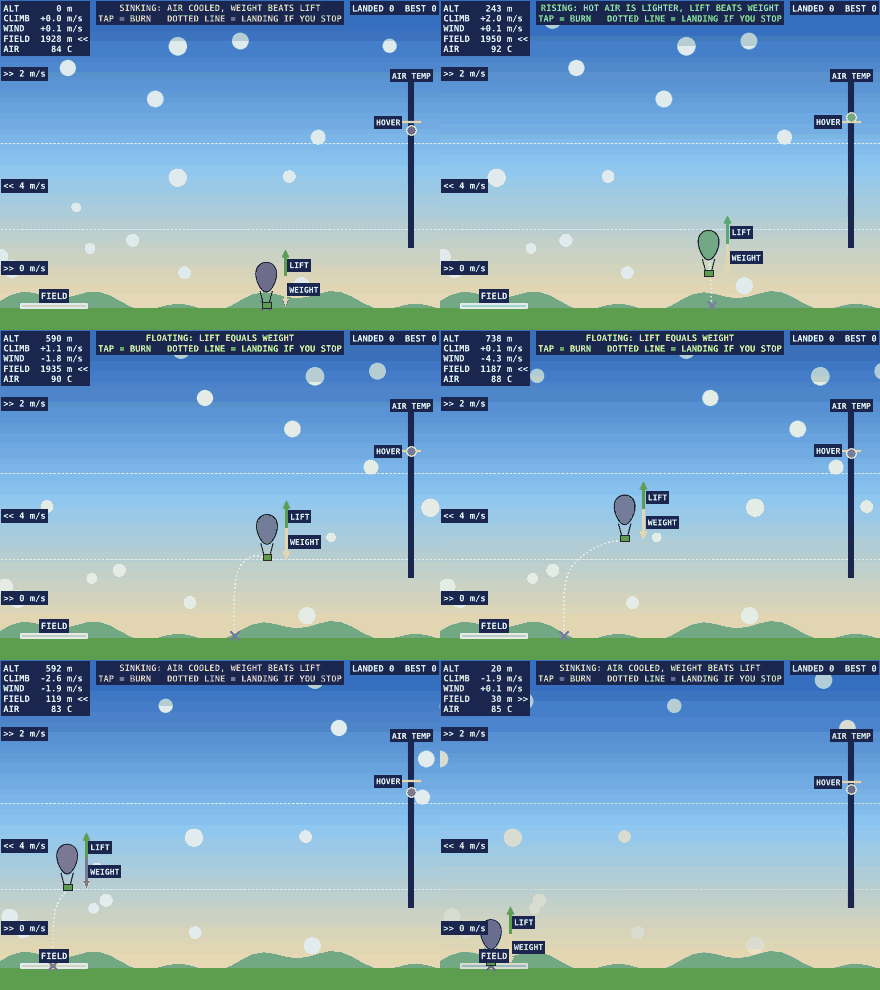
My One-Button Game Mini Hack entry, HOT AIR PILOT, is a hot-air balloon game with a single control. A tap fires the burner. The balloon rises while the air inside is hot, sinks as it cools, and drifts with whichever wind layer it is in. The goal is to land on a green field a couple of kilometers away.
The physics in a few lines
A balloon floats when the hot air inside it is lighter than the air outside. At the same pressure, density goes as one over absolute temperature, so the lift is
ri = r * To / T; % density of the hot air inside
lift = (r - ri) * V * 9.81; % upward force from the hot air
The game compares that lift with the weight of the envelope, basket and pilot, and applies drag. Heat leaks out with Newton's law of cooling, so the inside temperature relaxes toward the outside temperature. A burn adds 3 K. The result feels like holding a ball up with short pushes, because every burn fades away within a few seconds.Putting the lesson on the screen
Two gauges show the balance directly. A green arrow shows the lift and a red arrow shows the weight, and the text at the top reads RISING, FLOATING or SINKING depending on which is larger. On the right, a thermometer shows the inside temperature as a dot and the temperature needed to float as a yellow tick. Solving lift equals weight for the temperature gives the tick:
T = (288.15 - .0065*z) / (1 - M / (rho(z)*V));
As the balloon climbs the air gets thinner, so the tick moves up. Players learn to chase the tick with taps before anyone tells them why.
A forecast made from the same step function
The dotted line is the part players like most. It is the balloon's own update function run forward in 6-second steps with no more burns, until it touches the ground:
for k = 1:300
[x,z,vx,vz,T] = stp(S,x,z,vx,vz,T,6);
S.fx(k) = x; S.fz(k) = max(z,0);
if z <= 0, break; end
end
One function, stp, does both the real flight and the forecast, so the line is always consistent with the game. It bends where the wind changes and it slides sideways each time the player burns, which is wind shear and thermal lag drawn in one picture.
Moving clouds as a wind display
Wind layers need to be visible without a chart. Sixteen clouds are a single scatter object. Each cloud has its own altitude, and each frame its x position moves by the wind at that altitude:
S.cx = mod(S.cx + wnd(S,(S.cy-40)/.24)*12*dt + 50,900) - 50;
Because wnd accepts a vector, no loop is needed. Clouds in different layers slide in different directions, and a player sees the shear before reading a number.
Tuning with a script pilot
My first version let the balloon hover for many seconds after the last burn, and the landing point swung by hundreds of meters. I wrote a small pilot script that climbs, holds altitude and stops burning when the forecast reaches the field, and ran it over random flights. A shorter cooling time and smaller burns made the forecast steady enough to use. If your game has a skill a script can play, it is worth testing that the script can win at human reaction times.
Which wind layer did you end up using?
2 Comments
Time Descending
I have already voted for Hot Air Pilot!
I like how the temperature dependent buoyancy makes burner timing matter, while the tanh() blended wind layers let players steer by changing altitude. Reusing stp() for the dotted landing forecast is another clever touch- it gives players a practical way to judge when to stop burning and prepare for landing. Great example of physics directly driving gameplay!
Good job!

Thank you so much! It's good to see you enjoyed the game!
Sign in to participate
Tags

