FIELD FLIP: Tips, Tricks, and a Very Productive Way to Avoid Studying
So, I have a Calculus III midterm coming up. Naturally, instead of studying vector fields, I decided to make an entire game about them.
I'd call that studying, right?
After seeing that the MATLAB One-Button Game Mini Hack introduced a new STEM Education category, I immediately wanted to make something for it. Having spent the past few weeks learning about vector fields, divergence, curl, and line integrals, I figured this would be a fun way to put some of those concepts to use.
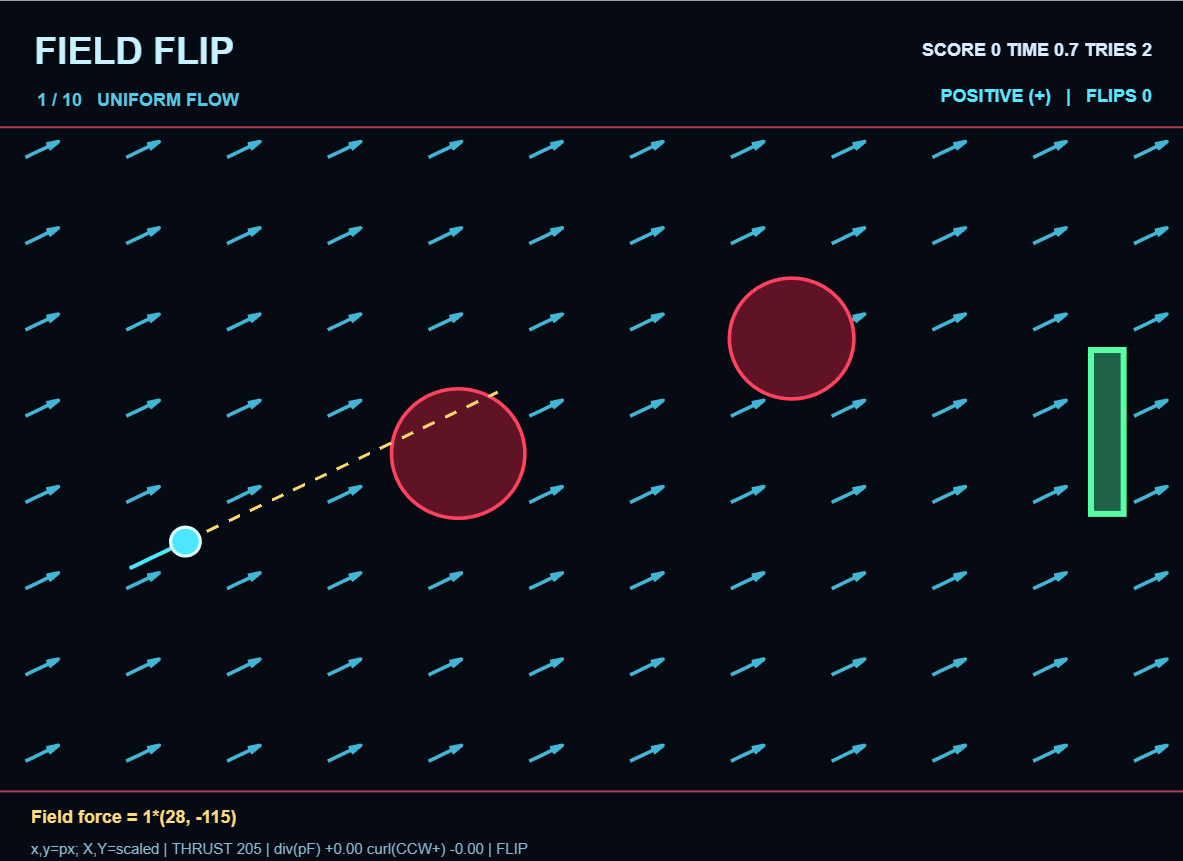
The idea is simple: you're a tiny particle navigating through a vector field, and your only ability is to reverse the direction of the field's force. Sounds easy enough, until you realize that Newton's laws of motion are not particularly interested in making your life easier.
With 10 increasingly challenging levels, you'll need to use momentum, polarity changes, and a little bit of vector calculus intuition to reach the exit.
How Do You Play?
You control a small particle traveling through a field of arrows. The arrows represent the combined force from the vector field and your particle's constant rightward thrust.
Your objective is to reach the green exit without crashing into any of the red obstacles or leaving the playable area.
There's just one button: SPACE (or click)!
- Your first tap starts the level.
- Every subsequent tap switches between positive and negative polarity.
- Positive polarity makes the field exert force in its original direction.
- Negative polarity reverses the field's force.
One thing to remember: flipping polarity doesn't instantly reverse your velocity!
Your particle has momentum. Even if the arrows suddenly point in the opposite direction, your particle might continue moving the same way until the opposing force slows it down.
Trust me, you'll become very familiar with this concept
The Yellow Line Is Your Best Friend!
You'll notice a dashed yellow line extending from your particle.
This is your predicted trajectory, calculated using the particle's current position, velocity, and forces.
It predicts approximately 1.7 seconds of movement, assuming you don't flip polarity again.
Rather than just hoping your particle avoids an obstacle, use this line to see where you're heading.
Pro tip: If the yellow line is heading straight into a giant red circle, you might want to, you know, press SPACE.
Don't Follow The Arrows Blindly!
The arrows show the direction of the current applied force, including thrust, but that doesn't necessarily mean your particle is moving in that direction.
Remember Newton's Second Law?
F = ma
Force changes acceleration, which changes velocity, which eventually changes position.
This means you need to anticipate where your particle will go rather than simply react to where it currently is.
A well-timed polarity flip can slow your particle down, redirect it, or help it narrowly avoid a collision.
A poorly timed flip can send it directly into an obstacle.
I have extensive experience with the second option.
The equation for the current field appears at the bottom of the screen, along with its divergence and curl.
You don't need to solve any integrals to beat the game, but understanding how the fields behave can make navigating them significantly easier.
Who knew Calculus III could actually be useful?
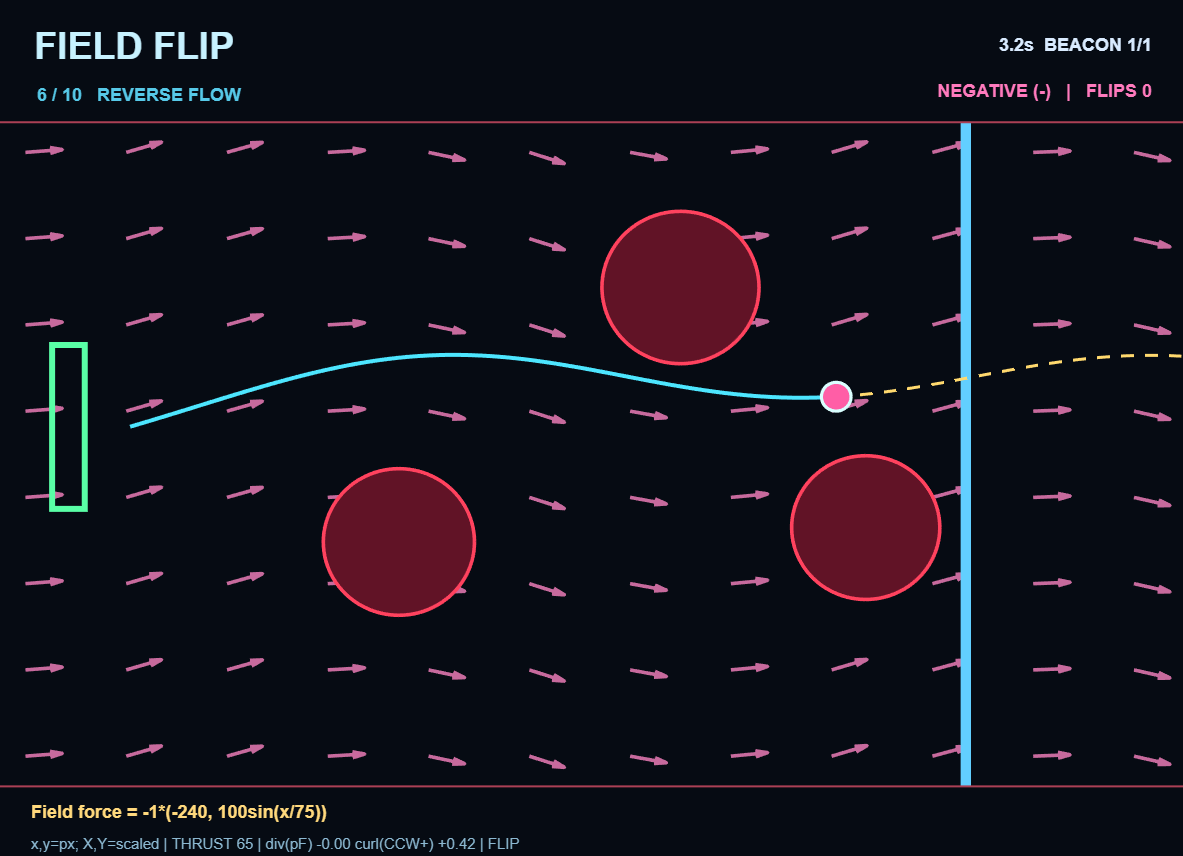
Things Get Interesting After Level 5
Your particle now has less rightward thrust, making it possible for the vector field to push you backward.
You'll also encounter beacons that must be collected before the exit unlocks.
Level 6 introduces the mechanic with one beacon. Levels 7–10 take things further, requiring you to travel back and forth across the field to collect three sequential beacons before returning to the exit on the left.
Yes, that means going through the obstacles multiple times.
And no, the obstacles do not become any friendlier on your second visit.
Some Final Advice
If there's one thing I hope players take away from FIELD FLIP, it's that a vector field describes how forces behave throughout space, but understanding motion requires considering velocity and acceleration too.
The particle doesn't magically follow whichever direction an arrow points. Its movement is the result of forces acting over time.
That distinction is what makes the gameplay interesting, and it's also one of the reasons I wanted to build the game in the first place.
Hopefully, FIELD FLIP makes vector fields a little more intuitive for anyone learning vector calculus, physics, or engineering.
And hopefully, creating it has somehow prepared me for my Calculus III midterm.
If not, at least I have a game to show for it.
Good luck, have fun, and try not to become too personally acquainted with the red circles...
Let me know what level you make it to, and whether you manage to beat all ten!
1 Comment
Time Descending
Thanks for sharing. Good luck with your midterm!
Sign in to participate
Tags


