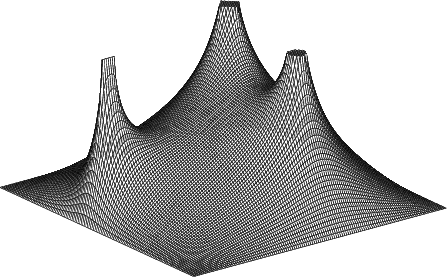
Efficient Primal-Dual Method for the Obstacle Problem
Solve 1D/2D non-linearized and linearized obstacle problems efficiently using primal-dual hybrid gradients with projection or L1 penalty.
https://link.springer.com/article/10.1007%2Fs10915-017-0420-0

You are now following this Submission
- You will see updates in your followed content feed
- You may receive emails, depending on your communication preferences
Cite As
Dominique Zosso (2026). Efficient Primal-Dual Method for the Obstacle Problem (https://in.mathworks.com/matlabcentral/fileexchange/71886-efficient-primal-dual-method-for-the-obstacle-problem), MATLAB Central File Exchange. Retrieved .
Zosso, Dominique, et al. “An Efficient Primal-Dual Method for the Obstacle Problem.” Journal of Scientific Computing, vol. 73, no. 1, Springer Nature, Mar. 2017, pp. 416–37, doi:10.1007/s10915-017-0420-0.
General Information
- Version 1.0.1 (8.87 KB)
MATLAB Release Compatibility
- Compatible with any release
Platform Compatibility
- Windows
- macOS
- Linux

