You are now following this Submission
- You will see updates in your followed content feed
- You may receive emails, depending on your communication preferences
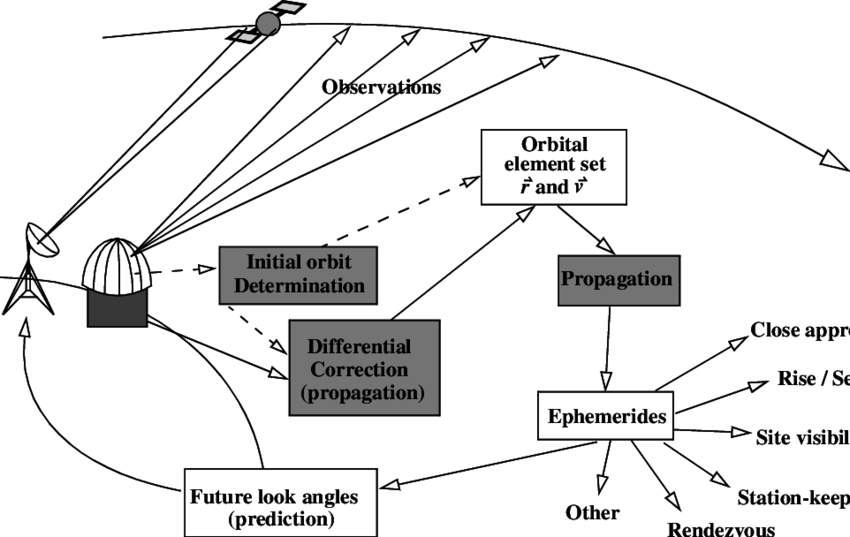
In favorable cases a satellite may allow simultaneous distance and angle measurements yielding directly the satellite's three-dimensional position relative to the ground station. Accounting for the known station location, these measurements can be converted to the position with respect to the center of the Earth. Only two of these position vectors (corresponding to six independent measurements) are then required to determine all six orbital elements in a unique way. The method described in the following comes from Gauss, and provides an efficient and robust way of solving the orbit determination problem for two given position vectors. Further methods like the Lambert-Euler method, the p-iteration and the use of f and g series are discussed in Escobal (1965) and Bate (1971).
References:
Montenbruck O., Gill E., "Satellite Orbits: Models, Methods and Applications," Springer Verlag, Heidelberg, Corrected 3rd Printing (2005).
Vallado D. A; Fundamentals of Astrodynamics and Applications; McGraw-Hill, New York; 4th edition (2013).
Cite As
Meysam Mahooti (2026). Initial orbit determination (https://in.mathworks.com/matlabcentral/fileexchange/77362-initial-orbit-determination), MATLAB Central File Exchange. Retrieved .
General Information
- Version 1.1.1 (701 KB)
MATLAB Release Compatibility
- Compatible with any release
Platform Compatibility
- Windows
- macOS
- Linux
