extrude
R2026bExtrude 2-D geometry or specified faces of 3-D geometry
Description
h = extrude(g,height,Name=Value)
h = extrude(g,FaceID,height)FaceID specifies which faces to extrude. You can extrude faces into
multiple layers by specifying height as a vector of thicknesses of the
layers.
All of the specified faces must be flat and have the same orientation. The extruded volumes must not intersect with each other or with the existing geometry.
Examples
Create a 3-D geometry by extruding a 2-D geometry along the z-axis.
Import a 2-D geometry.
g = fegeometry("PlateHolePlanar.stl");Plot the geometry and display the face labels.
pdegplot(g,FaceLabels="on")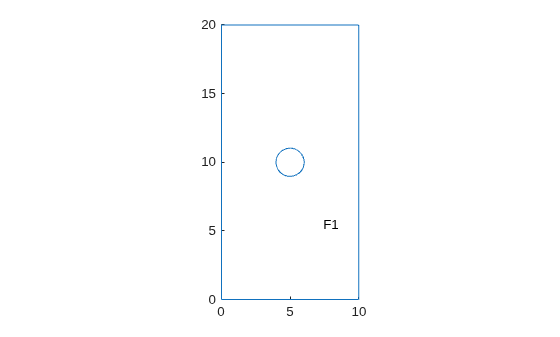
Create a 3-D geometry by extruding the 2-D geometry along the z-axis by 5 units.
g = extrude(g,5)
g =
  fegeometry with properties:

        NumCells: 1
        NumFaces: 7
        NumEdges: 15
     NumVertices: 10
        Vertices: [10×3 double]
    FeatureAngle: []
            Mesh: []
Plot the new geometry and display the face labels.
pdegplot(g,FaceLabels="on",FaceAlpha=0.5)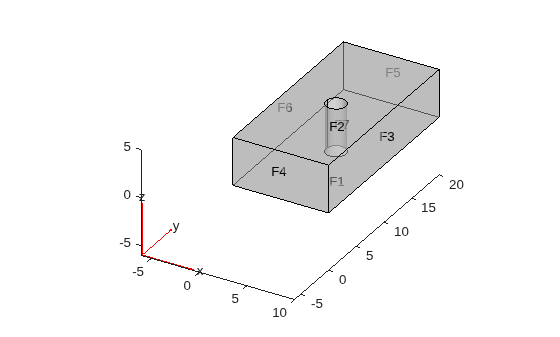
Create a stacked multilayered 3-D geometry by extruding a 2-D geometry along the z-axis.
Import a geometry.
g = fegeometry("PlateHolePlanar.stl")g =
fegeometry with properties:
NumCells: 0
NumFaces: 1
NumEdges: 5
NumVertices: 5
Vertices: [5×3 double]
FeatureAngle: []
Mesh: []
Plot the geometry and display the face labels.
pdegplot(g,FaceLabels="on")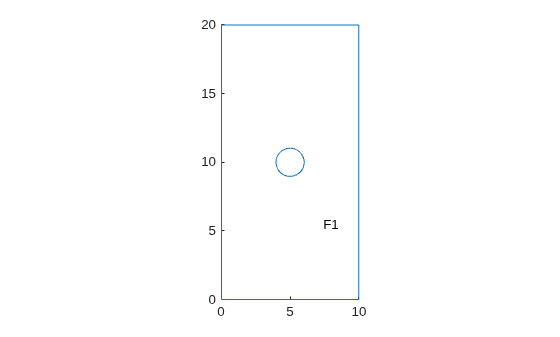
Create a 3-D geometry consisting of three blocks with holes stacked on top of each other. The heights of the blocks are 5, 10, and 20 units.
g = extrude(g,[5,10,20])
g =
  fegeometry with properties:

        NumCells: 3
        NumFaces: 19
        NumEdges: 35
     NumVertices: 20
        Vertices: [20×3 double]
    FeatureAngle: []
            Mesh: []
Plot the new geometry and display the cell labels.
pdegplot(g,CellLabels="on",FaceAlpha=0.5)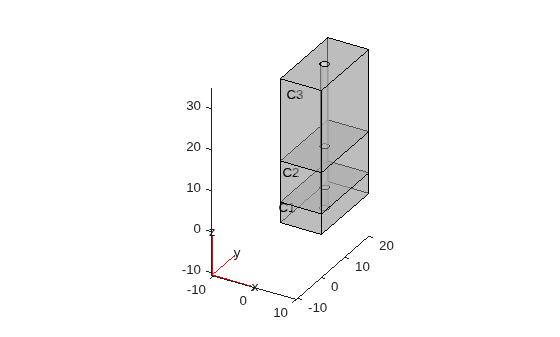
Extrude a 2-D geometry that has a vertex added by the addVertex function. The layers of the extruded geometry all have a corresponding vertex, but there are no edges between these vertices.
Import a geometry.
g = fegeometry("PlateHolePlanar.stl");Plot the geometry and display the vertex labels.
pdegplot(g,VertexLabels="on")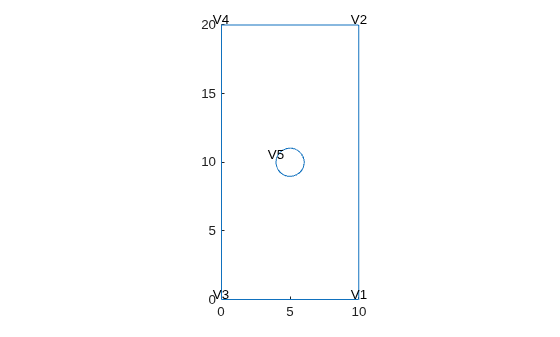
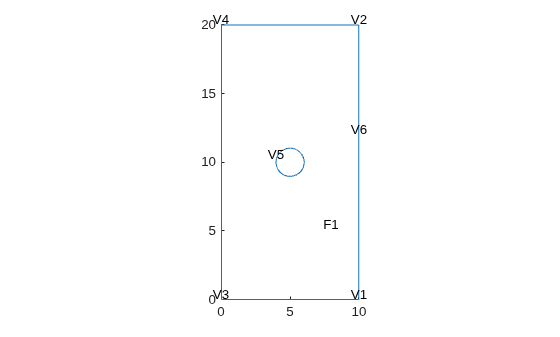
Add a new vertex on the right edge.
g = addVertex(g,Coordinates=[10 12]);
Plot the new geometry and display the vertex labels.
pdegplot(g,FaceLabels="on",VertexLabels="on")
Create a 3-D geometry consisting of three blocks with holes stacked on top of each other. The heights of the blocks are 5, 10, and 20 units.
g = extrude(g,[5,10,20])
g =
  fegeometry with properties:

        NumCells: 3
        NumFaces: 19
        NumEdges: 35
     NumVertices: 24
        Vertices: [24×3 double]
    FeatureAngle: []
            Mesh: []
Plot the new geometry and display the vertex labels. The extrude function replicates the added vertex V6 into three new vertices: V12, V18, and V24. It does not create edges between these vertices.
pdegplot(g,VertexLabels="on",FaceAlpha=0.5)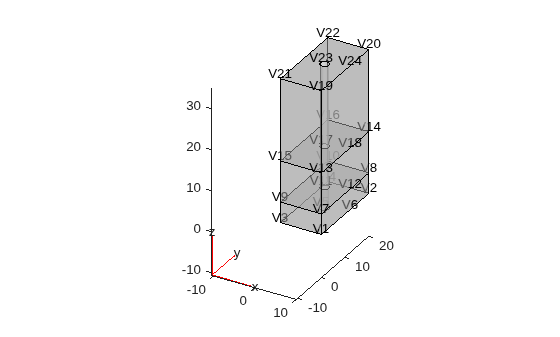
Extrude a 2-D geometry that has a face added by the addFace function.
Import a geometry.
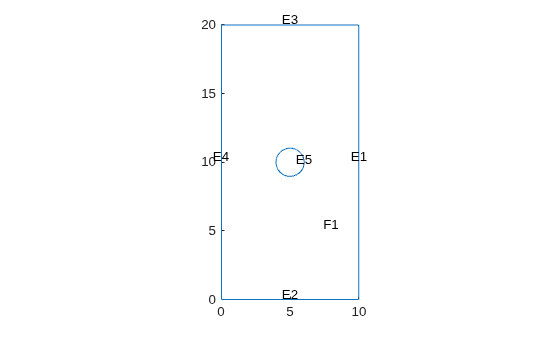
g = importGeometry("PlateHolePlanar.stl");Plot the geometry and display the face and edge labels.
pdegplot(g,FaceLabels="on",EdgeLabels="on")
Fill the hole in the center by adding a face.
g = addFace(g,5)
g =
  DiscreteGeometry with properties:

       NumCells: 0
       NumFaces: 2
       NumEdges: 5
    NumVertices: 5
       Vertices: [5×3 double]
Plot the modified geometry.
pdegplot(g,FaceLabels="on")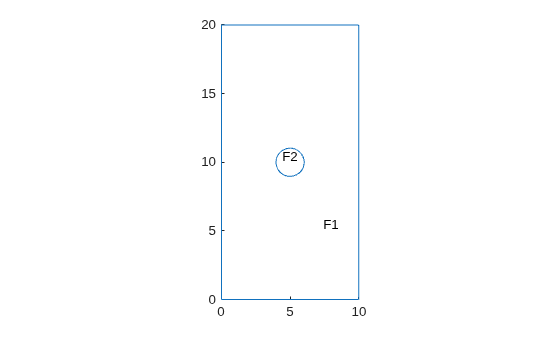
Create a 3-D geometry by extruding the 2-D geometry along the z-axis by 2 units.
g = extrude(g,2)
g =
  DiscreteGeometry with properties:

       NumCells: 2
       NumFaces: 9
       NumEdges: 15
    NumVertices: 10
       Vertices: [10×3 double]
Plot the new geometry and display the cell labels.
pdegplot(g,CellLabels="on",FaceAlpha=0.5)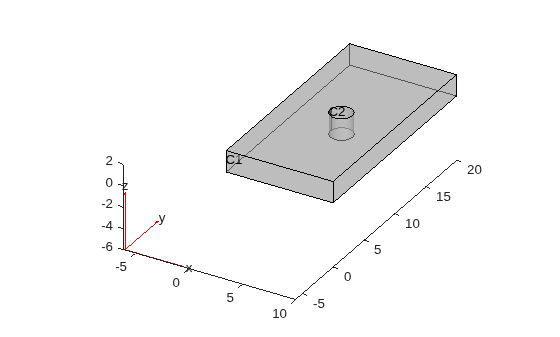
Since R2026b
Create a 2-D geometry by combining multiple unit squares and then subtracting a unit circle from the resulting geometry. Plot the 2-D geometry.
gmsquare = fegeometry(@squareg);
angle = [0 30 60];
for k = 1:numel(angle)
    gv(k) = rotate(gmsquare,angle(k));
end
gmcircle = fegeometry(@circleg);
gm = subtract(union(gv),gmcircle);
pdegplot(gm)
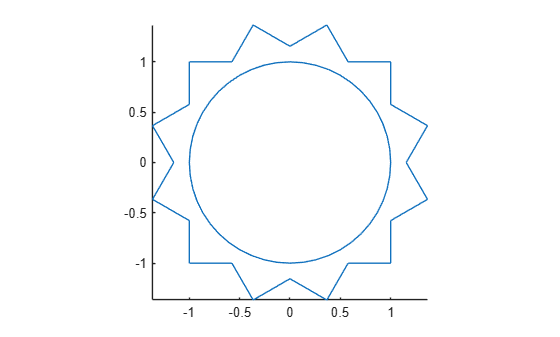
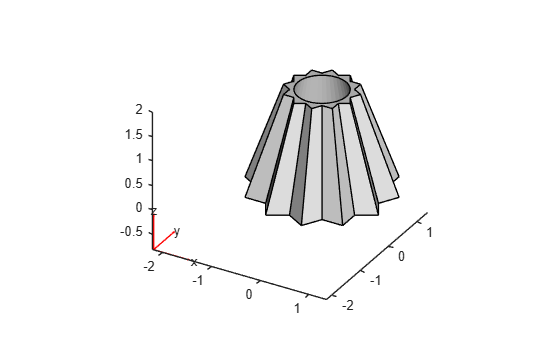
Extrude the 2-D geometry into a 3-D geometry, tapering the extrusion so that the top face of the resulting 3-D geometry is half the size of its bottom face.
gm3D = extrude(gm,2,Taper=0.5);
Plot the result.
pdegplot(gm3D)
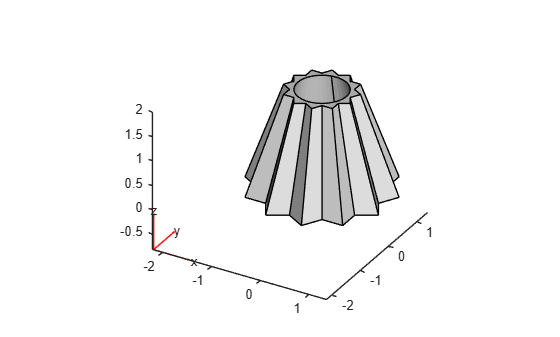
To remove the edge on the inner side of the resulting geometry, set the FeatureAngle property of the geometry to 50.
gm3D.FeatureAngle = 50;
pdegplot(gm3D)
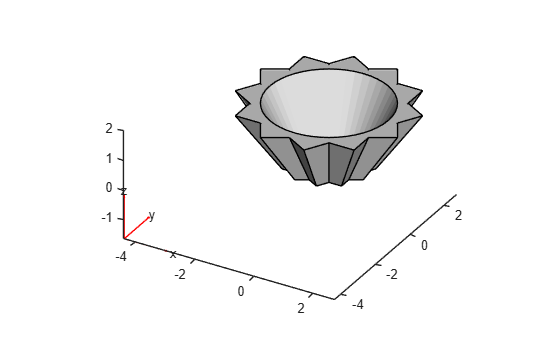
Now extrude the geometry so that the top face of the resulting 3-D geometry is twice the size of its bottom face.
gm3D = extrude(gm,2,Taper=2);
gm3D.FeatureAngle = 50;
pdegplot(gm3D)
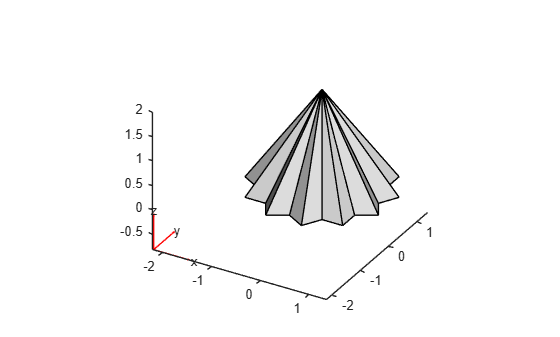
You can also shrink the top face to a single point by setting the Taper value to 0.
gm3D = extrude(gm,2,Taper=0);
pdegplot(gm3D)
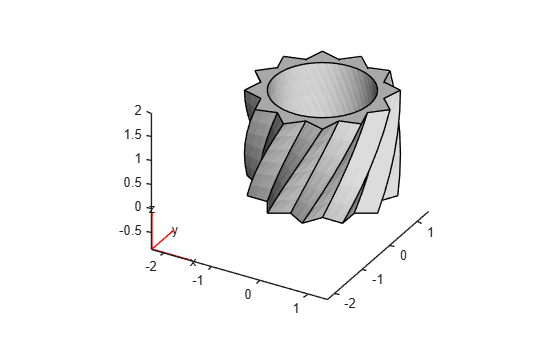
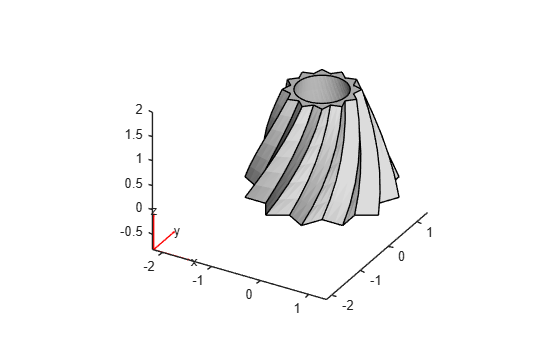
Extrude the 2-D geometry into a 3-D geometry and add a twist of 45 degrees to the extrusion.
gm3D = extrude(gm,2,Twist=45);
gm3D.FeatureAngle = 50;
pdegplot(gm3D)
Extrude the geometry and add both tapering and twisting.
gm3D = extrude(gm,2,Twist=45,Taper=0.5);
gm3D.FeatureAngle = 50;
pdegplot(gm3D)
Extrude specified faces of a 3-D geometry.
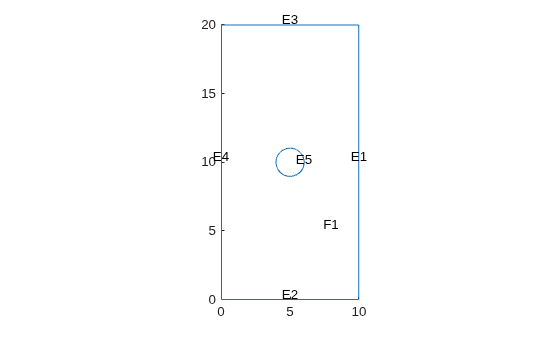
Import the geometry and plot it with the face and edge labels.
g = fegeometry("PlateHolePlanar.stl");
pdegplot(g,FaceLabels="on",EdgeLabels="on")
Fill the hole in the center by adding a face. Plot the modified geometry.
g = addFace(g,5);
pdegplot(g,FaceLabels="on")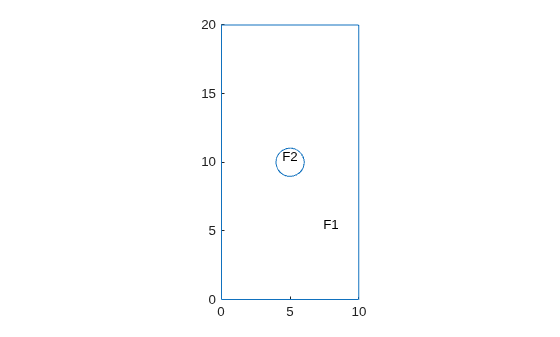
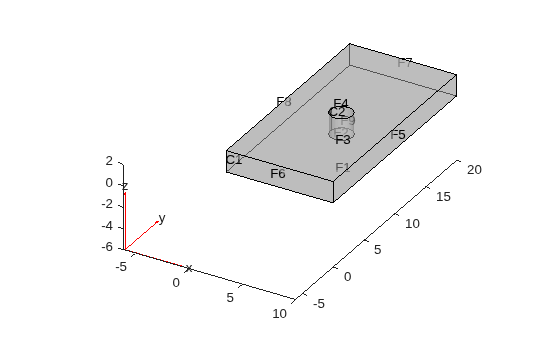
Create a 3-D geometry by extruding the 2-D geometry along the z-axis by 2 units.
g = extrude(g,2);
Plot the new geometry with the cell and face labels.
pdegplot(g,CellLabels="on",Facelabels="on",FaceAlpha=0.5)
Now, extrude the center face of the geometry by 5 units.
g = extrude(g,4,5);
Plot the resulting geometry with the cell labels.
pdegplot(g,CellLabels="on",FaceAlpha=0.5)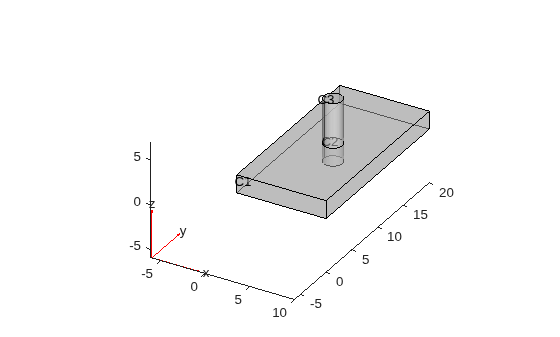
Now, call extrude again, and this time specify a vector of heights. The function extrudes all specified faces by each of the specified heights, which creates multiple layers.
g = extrude(g,[1 2],[3 4]);
pdegplot(g,CellLabels="on",FaceAlpha=0.5)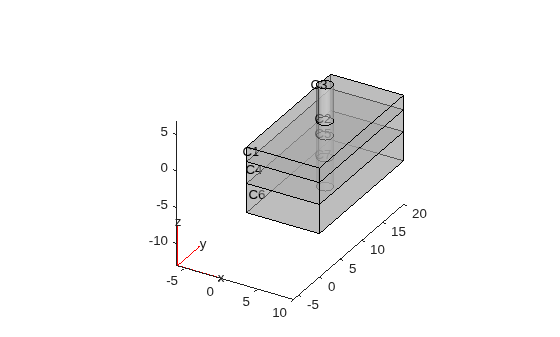
Input Arguments
Name-Value Arguments
Output Arguments
Tips
After modifying a geometry, regenerate the mesh to ensure a proper mesh association with the new geometry.
If a 2-D geometry has new vertices added by using the
addVertexfunction,extrudereplicates the new vertices on each new layer of the extruded 3-D geometry, but it does not connect these vertices by edges.If
gis anfegeometryorAnalyticGeometryobject, and you want to replace it with the modified geometry, assign the output to the original geometry, for example,g = extrude(g,20).Only 2-D geometry extrusion supports the
TaperandTwistname-value arguments.
Version History
Introduced in R2020bSee Also
Functions
addVertex|addFace|pdegplot|importGeometry|generateMesh|hull|mergeCells|multicuboid|multicylinder|multisphere|revolve

