Orbit Propagator Kepler (unperturbed)
R2026bPropagate orbit of one or more spacecraft using Kepler universal variable formulation
Orbit Propagator Kepler (unperturbed) block

To add a block to a model, double-click the canvas and start typing the block name. Then, select the block from the list.
Libraries:
Aerospace Blockset /
Spacecraft /
Spacecraft Dynamics
Alternative Configurations of Orbit Propagator Kepler (unperturbed) Block:
Orbit Propagator Numerical (high precision)
Description
The Orbit Propagator Kepler (unperturbed) block propagates the orbit of one or more spacecraft using the Kepler universal variable formulation. The Orbit Propagator Kepler (unperturbed) and Orbit Propagator Numerical (high precision) blocks are alternative configurations of the same block.
Orbit Propagator Kepler (unperturbed) — Kepler universal variable formulation (quicker)
Orbit Propagator Kepler Numerical (high precision) — More accurate
The Orbit Propagator Kepler (unperturbed) block does not take into account atmospheric drag, third body gravity, or solar radiation pressure. For orbit propagations that take these effects into account, see the Orbit Propagator Numerical (high precision) block.
The size of the provided initial conditions determines the number of spacecraft being modeled. If you supply more than one value for a parameter in the Orbit tab, the block outputs a constellation of satellites. Any parameter with a single provided value is expanded and applied to all the satellites in the constellation. For example, if you provide a single value for all the parameters on the block except True anomaly, which contains six values, the block creates a constellation of six satellites, varying true anomaly only.
The block applies the same expansion behavior to input port A_icrf (applied acceleration). This port accepts either a single value expanded to all spacecraft being modeled, or individual values to apply to each spacecraft.
For more information on the propagation methods the Orbit Propagator blocks use, see Orbit Propagation Methods.
You can define initial orbital states in the Orbit tab as:
A set of orbital elements
Position and velocity state vectors in International Celestial Reference Frame (ICRF) or fixed-frame coordinate systems.
The block uses quaternions, which are defined using the scalar-first convention.
For more information on the coordinate systems the Orbit Propagator blocks use, see Coordinate Systems.
Examples
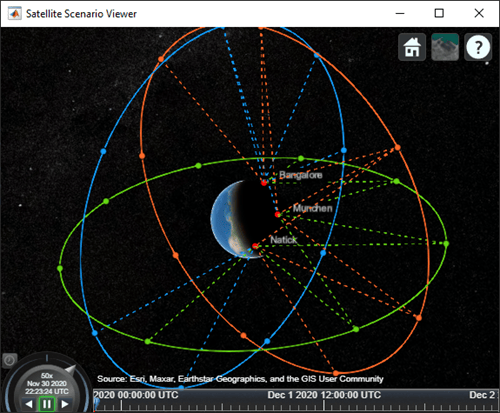
Constellation Modeling with the Orbit Propagator Block
Propagate the orbits of a constellation of satellites and compute and visualize access intervals between the individual satellites and several ground stations.
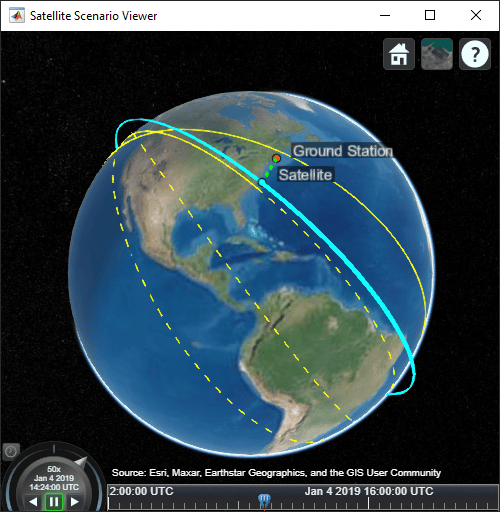
Mission Analysis with the Orbit Propagator Block
Compute and visualize line-of-sight access intervals between satellites and a ground station.
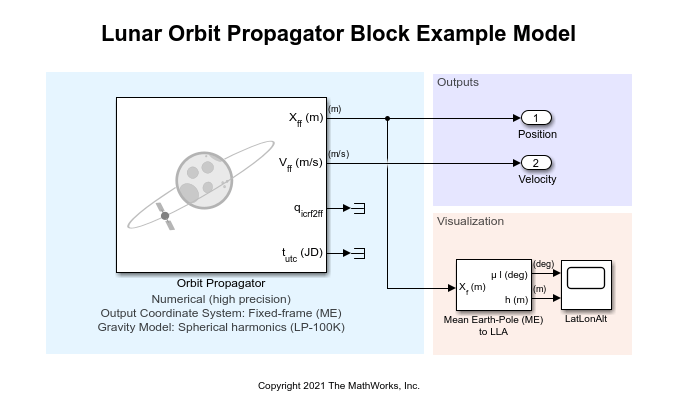
Lunar Mission Analysis with the Orbit Propagator Block
Compute and visualize access intervals between the Apollo Command and Service module and a rover on the lunar surface. The module's orbit is modeled using Reference Trajectory #2 from the NASA report Variations of the Lunar Orbital Parameters of the Apollo CSM-Module [2]. This is a lunar orbit studied by NASA for the Apollo program. The example uses:
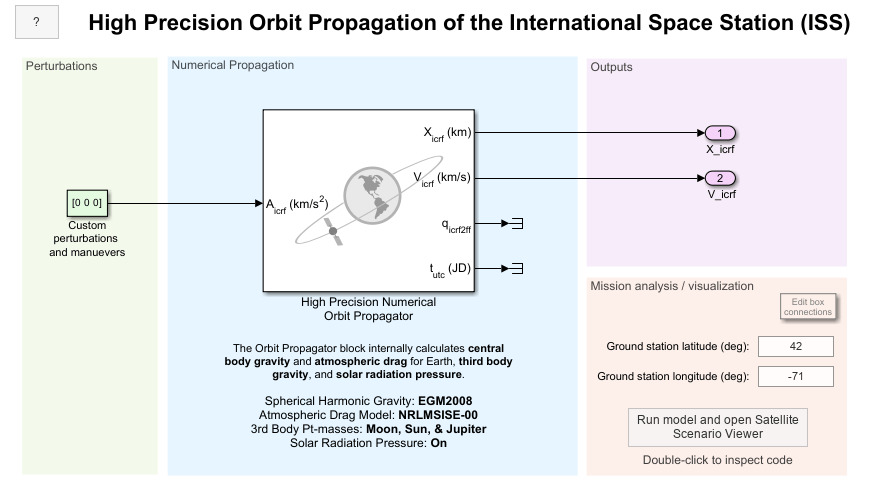
High Precision Orbit Propagation of the International Space Station
Propagate the order of the International Space Station (ISS) using high precision numerical orbit propagation.
Ports
Output
Parameters
Programmatic Use: Add Block
To add the block programmatically, use the add_block function with one of these library block paths as the source.
"aerolibsatdyn/Orbit Propagator Kepler (unperturbed)"
Example: add_block("aerolibsatdyn/Orbit Propagator Kepler (unperturbed)","myModel/myBlock",MakeNameUnique="on")
Alternative Configurations
Algorithms
The Orbit Propagator Kepler (unperturbed) block works in the ICRF and fixed-frame coordinate systems:
ICRF — International Celestial Reference Frame (ICRF). This frame can be treated as equal to the ECI coordinate system realized at J2000 (Jan 1 2000 12:00:00 TT. For more information, see ECI Coordinates).
To describe a point in space, you need a frame of reference that does not rotate with respect to the stars. The ICRF, with the origin at the center of the Earth and orthogonal vectors I, J, and K, is used as the frame of reference. The fundamental plane is the IJ-plane, which is closely aligned with the equator with a small offset that changes over time because of precession and nutation of the rotation axis of the Earth.

Fixed-frame — Fixed-frame is a generic term for the coordinate system that is fixed to the central body (its axes rotate with the central body and are not fixed in inertial space). For high precision orbit propagation methods
When the central body is earth, and the Earth orientation parameters (EOPs) are used, the Fixed-frame for Earth is the International Terrestrial Reference Frame (ITRF). This reference frame is realized by the IAU2000/2006 reduction from the ICRF coordinate system using the earth orientation parameter file provided. If Earth orientation parameters are not used, the block still uses the IAU2000/2006 reduction, but with Earth orientation parameters set to
0.When the central body is moon, and the moon libration angles are provided as input, the fixed-frame coordinate system for the moon is the Mean Earth/pole axis frame (ME). This frame is realized by two transformations. First, the values in the ICRF frame are transformed into the Principal Axis system (PA), the axis defined by the libration angles provided as inputs to the block. For more information, see Moon Libration. The states are then transformed into the ME system using a fixed rotation from the "Report of the IAU/IAG Working Group on cartographic coordinates and rotational elements: 2006" [5]. If the Moon libration angles input is not provided, the fixed frame is defined by the directions of the poles of rotation and prime meridians defined in the "Report of the IAU/IAG Working Group on cartographic coordinates and rotational elements: 2006" [5].
When the Central Body is custom, the fixed-frame coordinate system is defined by the poles of rotation and prime meridian defined by the block input α, δ, W, or the spin axis properties.
In all other cases, the fixed frame for each central body is defined by the directions of the poles of rotation and prime meridians defined in the "Report of the IAU/IAG Working Group on cartographic coordinates and rotational elements: 2006" [5].
References
[1] Vallado, David. Fundamentals of Astrodynamics and Applications, 4th ed. Hawthorne, CA: Microcosm Press, 2013.
[2] Gottlieb, R. G., "Fast Gravity, Gravity Partials, Normalized Gravity, Gravity Gradient Torque and Magnetic Field: Derivation, Code and Data," Technical Report NASA Contractor Report 188243, NASA Lyndon B. Johnson Space Center, Houston, Texas, February 1993.
[3] Konopliv, A. S., S. W. Asmar, E. Carranza, W. L. Sjogren, D. N. Yuan., "Recent Gravity Models as a Result of the Lunar Prospector Mission, Icarus", Vol. 150, no. 1, pp 1–18, 2001.
[4] Lemoine, F. G., D. E. Smith, D.D. Rowlands, M.T. Zuber, G. A. Neumann, and D. S. Chinn, "An improved solution of the gravity field of Mars (GMM-2B) from Mars Global Surveyor", Journal Of Geophysical Research, Vol. 106, No. E10, pp 23359-23376, October 25, 2001.
[5] Seidelmann, P.K., Archinal, B.A., A’hearn, M.F. et al. "Report of the IAU/IAG Working Group on cartographic coordinates and rotational elements: 2006." Celestial Mech Dyn Astr 98, 155–180 (2007).
[6] Montenbruck, Oliver, and Gill Eberhard. Satellite Orbits: Models, Methods, and Applications. Springer, 2000.

