cpsd
Cross power spectral density
Syntax
Description
pxy = cpsd(x,y)x and y, using Welch’s averaged,
modified periodogram method of spectral estimation.
If
xandyare both vectors, they must have the same length.If one of the signals is a matrix and the other is a vector, then the length of the vector must equal the number of rows in the matrix. The function expands the vector and returns a matrix of column-by-column CPSD estimates.
If
xandyare matrices with the same number of rows but different numbers of columns, thencpsdreturns a three-dimensional array,pxy, containing CPSD estimates for all combinations of input columns. Each column ofpxycorresponds to a column ofx, and each page corresponds to a column ofy:pxy(:,m,n) = cpsd(x(:,m),y(:,n)).If
xandyare matrices of equal size, thencpsdoperates column-wise:pxy(:,n) = cpsd(x(:,n),y(:,n)). To obtain a multi-input/multi-output array, append"mimo"to the argument list.
The function returns either a one-sided or two-sided CPSD
estimate if you specify x and y as
real-valued or complex-valued signals, respectively.
[
returns a vector of frequencies, pxy,f] = cpsd(___,Fs)f, expressed in terms of
the sample rate, Fs, at which the function estimates the
CPSD. Fs must be the sixth numeric input to
cpsd. To input a sample rate and still use the default
values of the preceding optional arguments, specify these arguments as empty,
[].
cpsd(___) with no output arguments plots
the CPSD estimate in the current figure window.
Examples
Generate two colored noise signals and plot their cross power spectral density. Specify a length-1024 FFT and a 500-point triangular window with 50% overlap between segments. Reset the random number generator for reproducible results.
rng("default")
r = randn(2e4,1);

hx = fir1(30,0.2,rectwin(31));
x = filter(hx,1,r);

hy = ones(1,10);
y = filter(hy,1,r);

win = triang(500);
nov = 250;

cpsd(x,y,win,nov,1024)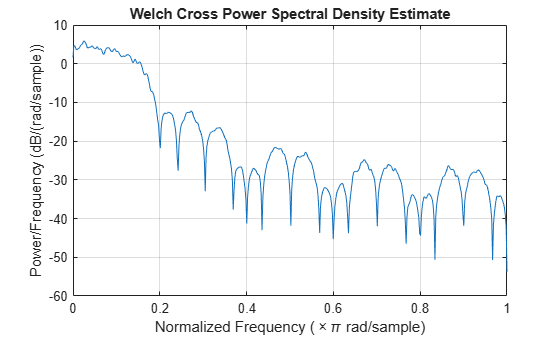
Generate two two-channel sinusoids sampled at 1 kHz for 1 second. The channels of the first signal have frequencies of 200 Hz and 300 Hz. The channels of the second signal have frequencies of 300 Hz and 400 Hz. Both signals are embedded in unit-variance white Gaussian noise. Reset the random number generator for reproducible results.
rng("default")
fs = 1e3;
t = (0:1/fs:1-1/fs)';

q = 2*sin(2*pi*[200 300].*t);
q = q + randn(size(q));

r = 2*sin(2*pi*[300 400].*t);
r = r + randn(size(r));
Compute the cross power spectral density of the two signals. Use a 256-sample Bartlett window to divide the signals into segments and window the segments. Specify 128 samples of overlap between adjoining segments and 2048 DFT points. Use the built-in functionality of cpsd to plot the result.
cpsd(q,r,bartlett(256),128,2048,fs)
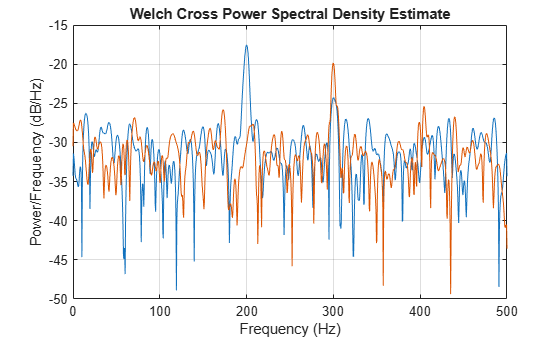
By default, cpsd works column-by-column on matrix inputs of the same size. Each channel peaks at the frequencies of the original sinusoids.
Repeat the calculation, but now append "mimo" to the list of arguments.
cpsd(q,r,bartlett(256),128,2048,fs,"mimo")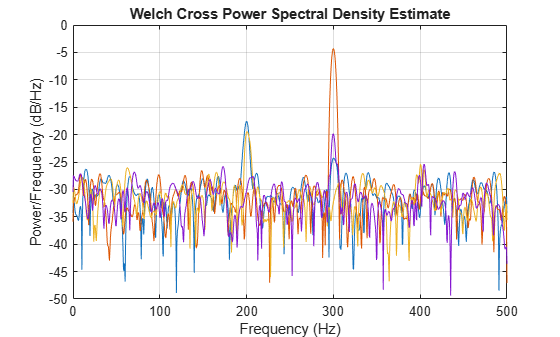
When called with the "mimo" option, cpsd returns a three-dimensional array containing cross power spectral density estimates for all combinations of input columns. The estimate of the second channel of q and the first channel of r shows an enhanced peak at the common frequency of 300 Hz.
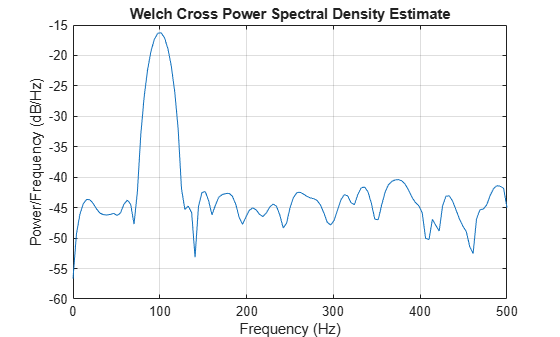
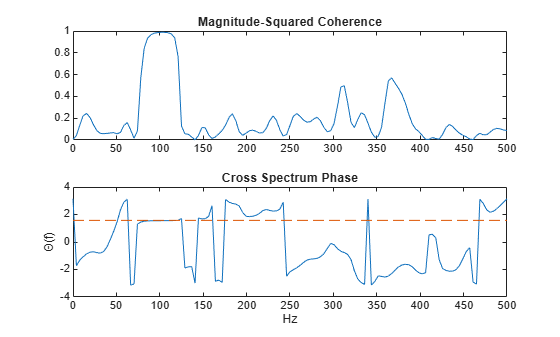
Generate two 100 Hz sinusoidal signals sampled at 1 kHz for 296 ms. One of the sinusoids lags the other by 2.5 ms, equivalent to a phase lag of π/2. Both signals are embedded in white Gaussian noise of variance 1/4². Reset the random number generator for reproducible results.
rng("default")
Fs = 1000;
t = 0:1/Fs:0.296;

x = cos(2*pi*t*100) + 0.25*randn(size(t));
tau = 1/400;
y = cos(2*pi*100*(t-tau)) + 0.25*randn(size(t));
Compute and plot the magnitude of the cross power spectral density. Use the default settings for cpsd. The magnitude peaks at the frequency where there is significant coherence between the signals.
cpsd(x,y,[],[],[],Fs)
Plot magnitude-squared coherence function and the phase of the cross spectrum. The ordinate at the high-coherence frequency corresponds to the phase lag between the sinusoids.
[Cxy,F] = mscohere(x,y,[],[],[],Fs);

[Pxy,~] = cpsd(x,y,[],[],[],Fs);

figure
tiledlayout("flow")
nexttile
plot(F,Cxy)
title("Magnitude-Squared Coherence")
nexttile
plot(F,angle(Pxy),F,2*pi*100*tau*ones(size(F)),"--")
xlabel("Hz")
ylabel("\Theta(f)")
title("Cross Spectrum Phase")
Generate two -sample exponential sequences, and , with . Specify , , and a small to see finite-size effects.
N = 10;
n = 0:N-1;

a = 0.8;
b = 0.9;

xa = a.^n;
xb = b.^n;
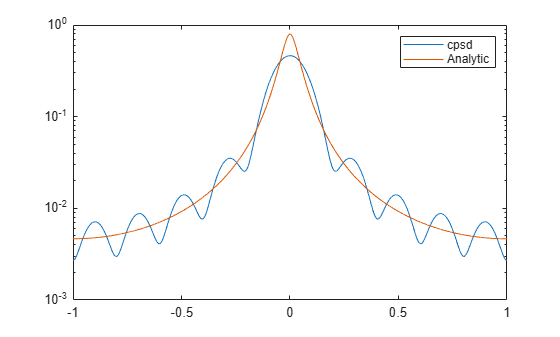
Compute and plot the cross power spectral density of the sequences over the complete interval of normalized frequencies, . Specify a rectangular window of length and no overlap between segments.
w = -pi:1/1000:pi;
wind = rectwin(N);
nove = 0;

[pxx,f] = cpsd(xa,xb,wind,nove,w);
The cross power spectrum of the two sequences has an analytic expression for large :
Convert this expression to a cross power spectral density by dividing it by . Compare the results. The ripple in the cpsd result is a consequence of windowing.
nfac = 2*pi*N;

X = 1./(1-a*exp(-1j*w));
Y = 1./(1-b*exp( 1j*w));
R = X.*Y/nfac;

semilogy(f/pi,abs(pxx))
hold on
semilogy(w/pi,abs(R))
hold off
legend(["cpsd" "Analytic"])
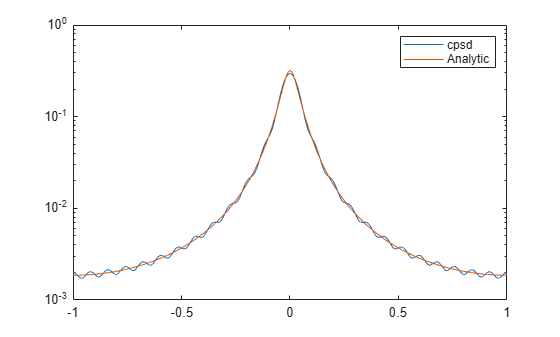
Repeat the calculation with . The curves agree to six figures for as small as 100.
N = 25;
n = 0:N-1;
xa = a.^n;
xb = b.^n;

wind = rectwin(N);

[pxx,f] = cpsd(xa,xb,wind,nove,w);
R = X.*Y/(2*pi*N);

semilogy(f/pi,abs(pxx))
hold on
semilogy(w/pi,abs(R))
hold off
legend(["cpsd" "Analytic"])
Use cross power spectral density to identify a highly corrupted tone.
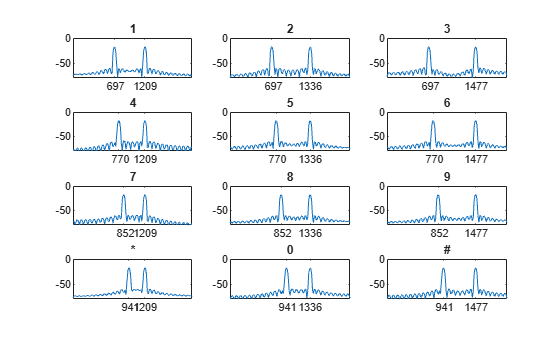
The sound signals generated when you dial a number or symbol on a digital phone are sums of sinusoids with frequencies taken from two different groups. Each pair of tones contains one frequency of the low group (697 Hz, 770 Hz, 852 Hz, or 941 Hz) and one frequency of the high group (1209 Hz, 1336 Hz, or 1477 Hz).
Generate signals corresponding to all the symbols. Sample each tone at 4 kHz for half a second. Prepare a reference table.
fs = 4e3;
t = 0:1/fs:0.5-1/fs;

nms = ["1";"2";"3";"4";"5";"6";"7";"8";"9";"*";"0";"#"];

ver = [697 770 852 941];
hor = [1209 1336 1477];

v = length(ver);
h = length(hor);

for k = 1:v
    for l = 1:h
        idx = h*(k-1)+l;
        tone = sum(sin(2*pi*[ver(k);hor(l)].*t))';
        tones(:,idx) = tone;
    end
end
Plot the Welch periodogram of each signal and annotate the component frequencies. Use a 200-sample Hamming window to divide the signals into non-overlapping segments and window the segments.
[pxx,f] = pwelch(tones,hamming(200),0,[],fs);

for k = 1:v
    for l = 1:h
        idx = h*(k-1)+l;
        ax = subplot(v,h,idx);
        plot(f,pow2db(pxx(:,idx)))
        ylim([-80 0])
        title(nms(idx))
        tx = [ver(k);hor(l)];
        ax.XTick = tx;
        ax.XTickLabel = int2str(tx);
    end
end
A signal produced by dialing the number 8 is sent through a noisy channel. The received signal is so corrupted that the number cannot be identified by inspection. Reset the random number generator for reproducible results.
rng("default")
mys = sum(sin(2*pi*[ver(3);hor(2)].*t))' + 5*randn(size(t'));

% To hear, type soundsc(mys,fs)
Compute the cross power spectral density of the corrupted signal and the reference signals. Window the signals using a 512-sample Kaiser window with shape factor β = 5. Plot the magnitude of each spectrum.
[pxy,f] = cpsd(mys,tones,kaiser(512,5),100,[],fs);

for k = 1:v
    for l = 1:h
        idx = h*(k-1)+l;
        ax = subplot(v,h,idx);
        plot(f,pow2db(abs(pxy(:,idx))))
        ylim([-80 0])
        title(nms(idx))
        tx = [ver(k);hor(l)];
        ax.XTick = tx;
        ax.XTickLabel = int2str(tx);
    end
end
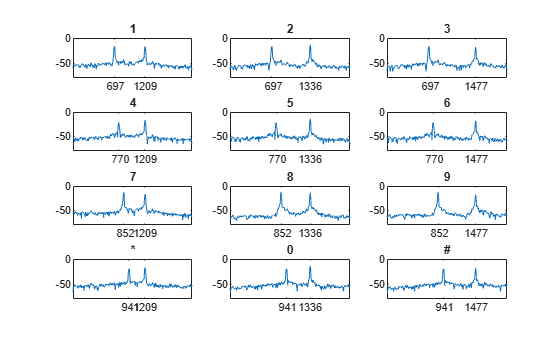
The digit in the corrupted signal has the spectrum with the highest peaks and the highest RMS value.
[~,loc] = max(rms(abs(pxy)));

digit = nms(loc)
digit =
"8"
Since R2026a
Plot the Welch cross power spectral density (CPSD) estimate for a MIMO system in the specified target axes and panel containers.
Two masses connected to a spring and a damper on each side form an ideal one-dimensional discrete-time oscillating system. The system input array u consists of random driving forces applied to the masses. The system output array y contains the observed displacements of the masses from their initial reference positions. The system is sampled at a rate Fs of 40 Hz.
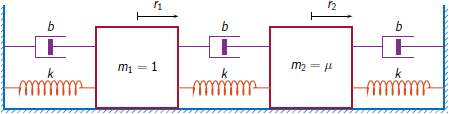
Load the data file containing the MIMO system inputs, the system outputs, and the sample rate. The example Frequency-Response Analysis of MIMO System analyzes the system that generated the data used in this example.
load MIMOdata Fs u y
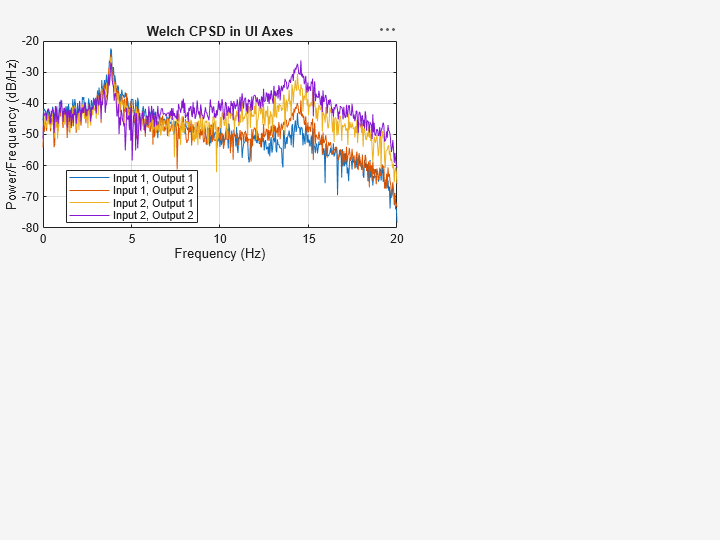
Estimate the Welch CPSD of the system and plot the estimate on a UI axes. Divide the signal into 5000-sample segments with 50% overlap between adjoining segments. Apply a Hanning window to each segment and calculate the discrete Fourier transform of the signal segment using 1024 frequency points. Select the "mimo" option to produce all four estimates.
uif = uifigure(Position=[100 100 720 540]);
ax = uiaxes(uif,Position=[5 280 400 240]);

g = hann(5000);
ol = 2500;
nfft = 1024;

cpsd(u,y,g,ol,nfft,Fs,"mimo",Parent=ax)
legend(ax,"Input "+[1 2]+", Output "+[1 2]',Location="best")
title(ax,"Welch CPSD in UI Axes")
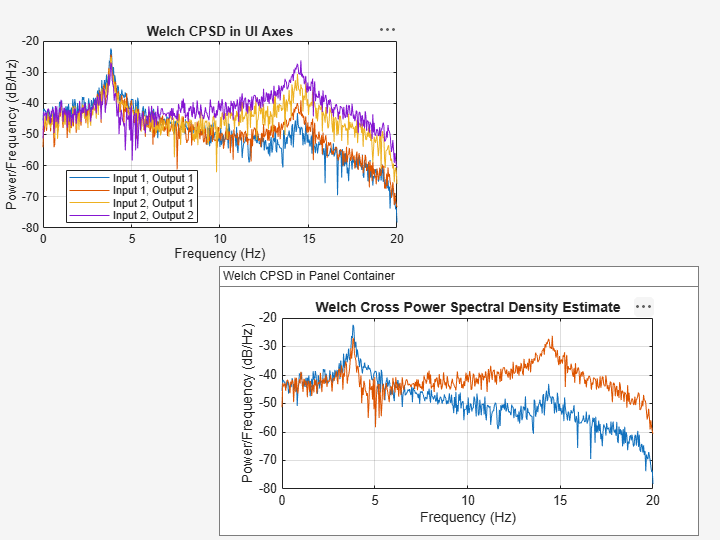
Add a panel container in the southeastern corner of the UI figure window.
p = uipanel(uif,Position=[220 5 480 270], ...
    Title="Welch CPSD in Panel Container", ...
    BackgroundColor="white");
Plot the Welch CPSD estimate of each input-output pair of the system.
cpsd(u,y,g,ol,nfft,Fs,Parent=p)
Input Arguments
Output Arguments
More About
Algorithms
cpsd uses Welch’s averaged, modified
periodogram method of spectral estimation.
References
[1] Oppenheim, Alan V., Ronald W. Schafer, and John R. Buck. Discrete-Time Signal Processing. 2nd Ed. Upper Saddle River, NJ: Prentice Hall, 1999.
[2] Rabiner, Lawrence R., and B. Gold. Theory and Application of Digital Signal Processing. Englewood Cliffs, NJ: Prentice-Hall, 1975, pp. 414–419.
[3] Welch, Peter D. “The Use of the Fast Fourier Transform for the Estimation of Power Spectra: A Method Based on Time Averaging Over Short, Modified Periodograms.” IEEE® Transactions on Audio and Electroacoustics, Vol. AU-15, June 1967, pp. 70–73.

